From Fan Letter to Fan Club: A Short History of Belonging
Fan letters and fan clubs express attachment in different ways, from a private note to shared rituals, records, and a community that lasts beyond one show.
A fan letter makes attachment personal; a fan club makes it shareable. The history of belonging in fandom is not a simple shift from one to the other: private notes and organised communities have often existed side by side, each giving people a different way to care about an entertainer or a show.
The distinction is useful because these forms leave different traces. A letter addresses someone at a distance, while a club builds connections among people who share that distance. Here are seven ways to understand what changes as fandom moves between the page and the group.
1. A letter makes admiration specific
A fan letter begins with one person choosing what to say. The writer might mention a scene, a song, a performance choice, or the comfort of returning to a familiar character. That detail distinguishes the letter from general applause: it shows how a work met an individual imagination.
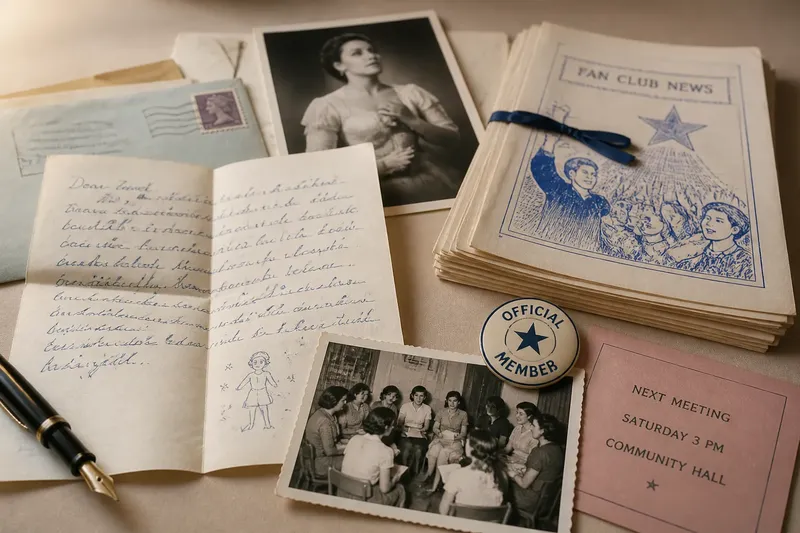
The form also preserves the writer’s voice. A carefully composed page, a hurried postcard, and a note decorated with a small drawing all express different kinds of attention. Even when a letter is never answered, writing it can turn a passing feeling into a considered statement.
Letters can also carry the pressures of their moment. A fan may be writing through an official address, relying on a magazine for contact information, or unsure whether anyone will read the message. The effort of sending a note gives it a one-to-one quality, but it does not create a conversation among fans by itself.
2. Shared channels create company
A club changes the audience for an expression of admiration. Instead of speaking only toward a performer or production, members speak to one another. They can trade interpretations, collect news, and recognise familiar names over time.
Those connections need not depend on a formal organization. Readers of a fan magazine might write to one another through a printed address column; theatre-goers might arrange to meet after a performance; viewers might discuss episodes in a local group. Each channel creates a place where enthusiasm is met with recognition rather than simply sent outward.
That recognition is a form of belonging, but it can be modest. A person may be a regular reader rather than an officer, or attend a gathering without taking on a public role. The important change is that appreciation becomes social: someone else can respond, disagree, or add a memory of their own.
3. Club routines make identity visible
Organised fandom becomes legible through repeated practices. A club may circulate a newsletter, hold meetings, exchange photographs, or coordinate attendance at a show. These routines give members a shared rhythm, helping a scattered interest feel like a community.
Membership can also provide a name for an attachment. A person who joins a club is not merely someone who likes a performer; they are part of a group with recognizable customs and a way of communicating. That identity can be welcoming, especially for fans whose enthusiasm is not understood by people around them.
Yet visibility has a trade-off. A club’s symbols and habits may make outsiders assume that every member thinks alike. In reality, one fan might care most about a particular role, another about the craft of performance, and another about the friendships formed around the show. Shared identity does not erase individual reasons for joining.
4. Gatekeeping shapes who belongs
Any community has boundaries, whether or not it writes them down. A club might require dues, a recommendation, regular participation, or agreement with its customs. Informal groups can have boundaries too: inside jokes, insider knowledge, and established friendships may make newcomers feel that they have arrived late.
These limits affect whose fandom becomes visible in the record. A club archive may preserve official newsletters and event notices while overlooking casual members who never held an office. A pile of personal letters may preserve individual voices that were not represented in club records. Neither kind of evidence tells the entire story on its own.
Belonging also changes as a person’s circumstances change. Someone may leave a club but continue to value the performer, or stop writing letters while keeping a lasting connection to the show. Participation is not a reliable measure of the depth of attachment; it is one way that attachment takes shape.
5. Fan mail and club work differ
Private correspondence usually centres on expression: what the fan wants to say, and what the recipient might hear in it. Club activity adds practical work. Someone has to share information, keep records, arrange a meeting, or decide what belongs in a newsletter.
That work can make admiration durable. A letter might preserve one person’s response to a performance, while a club’s papers can reveal how members kept the interest active across many conversations. But administration can also become a burden, especially when a small number of members carry most of the effort.
Imagine a new admirer who writes a note after seeing a touring production, then finds a local club through a notice in a theatre programme. The note lets that person name a particular moment that mattered; attending a meeting gives them a chance to hear how other viewers interpreted it. The expected observable result is not a stronger or more authentic kind of fandom, but two distinct records: one personal account and one shared conversation.
6. Media change the scale of contact
Each communication medium alters the pace and reach of fandom. Postal letters take time to travel and can feel deliberately composed. A printed newsletter gathers contributions into one object, while telephone trees or online groups allow members to coordinate more quickly. New channels make contact easier to repeat, but they do not automatically make it more intimate.
Speed can encourage a steady flow of updates, reactions, and reminders. It can also make older forms seem slow or unnecessary. That judgment misses what a physical letter or club bulletin offers: a bounded object that can be kept, reread, and passed to someone else. A digital message may be easier to share, yet its context can disappear when a platform or group changes.
What is not worth the effort is ranking every medium as either more sincere or more meaningful. A handwritten letter can be formulaic, and a brief online exchange can matter deeply to its participants. The useful question is what a channel lets fans do together, and what it leaves out.
7. Archives preserve different kinds of belonging
Fan letters and club materials survive unevenly. A family might keep a letter in a drawer, while a club might preserve minutes, membership lists, or event flyers. Either collection can be incomplete: ordinary notes are easily discarded, and formal records often favour the people who managed the group.
When looking at these objects, read for both content and form. Who is addressed? Does the writer speak as an individual or on behalf of members? Does a newsletter invite contributions, announce decisions, or draw a boundary around who counts as part of the group? Such clues show how belonging was expressed and organized, without assuming that one preserved item speaks for every fan.
Careful handling matters if an item includes personal addresses or private correspondence. A club record may reveal information about members who did not expect it to circulate widely. For public sharing or donation decisions, consider the privacy of the people named and seek guidance from an archivist or the relevant institution where appropriate.
Questions readers ask?
What is the difference between a fan letter and a fan club?
A fan letter is a personal message directed toward an entertainer or production, while a fan club organizes contact among people who share an interest. A letter can express a particular response; a club can sustain conversation and coordinated activity.
Did fan clubs replace fan letters?
No. The forms can coexist because they serve different purposes. A member may write privately to express a response and also take part in a group that shares news or plans gatherings.
Why did fans join clubs?
Joining could offer companionship, information, shared events, and a name for an interest that might otherwise feel solitary. The reasons varied, and participation did not require every member to relate to the entertainer or show in the same way.
What can fan mail reveal to historians?
Letters can reveal the details that individual fans noticed, the language they used, and the feelings they chose to share. They need to be read alongside other evidence, since surviving letters cannot represent everyone who watched, listened, or attended.
Belonging has more than one shape
The path from fan letter to fan club is best understood as a change in scale, not a replacement of private feeling by public identity. One form gives a fan a voice directed toward a performer or show; the other gives fans ways to recognise one another and keep an interest active.
That distinction still helps when interpreting fandom’s surviving traces. A single letter may tell a vivid story of attention, while club records show how people made that attention social. Together they reveal not only what fans admired, but how they found company in admiring it.