Programme or Poster: Which Keeps the Better Memory?
Compare a programme and a poster by the details each preserves, then choose the keepsake that best matches the part of a performance you want to remember.
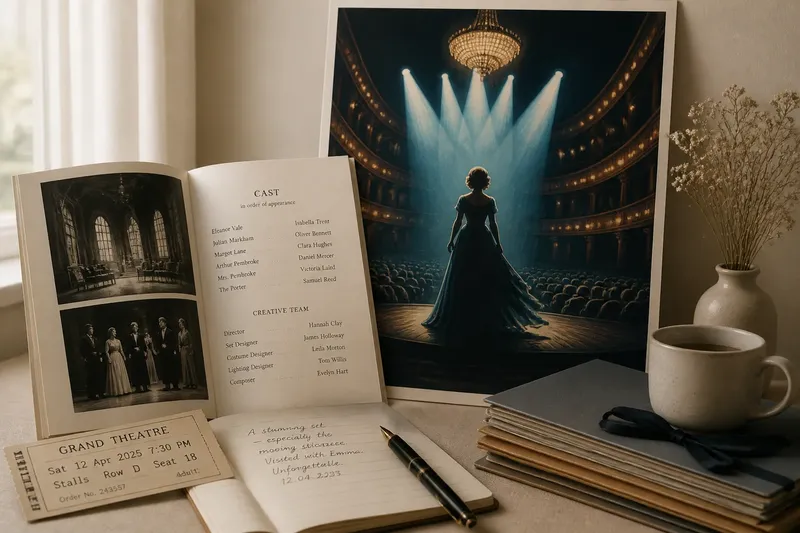
A programme and a poster preserve different memories of a performance, so the better keepsake depends on what you want to recall. A programme tends to hold the evening’s specific details: names, roles, credits and sometimes a note or photograph. A poster keeps the event’s public image—the title, design and visual mood that caught your attention before the performance began.
Choosing between them can be surprisingly tricky. One may be easier to store, the other more evocative; one may have a richer record of who made the show, while the other brings back its look at a glance. A few common selection problems point toward the right object.
Memory feels too general
If you remember only that you enjoyed the evening, a poster may seem like the obvious choice. Its graphic design, colors and large title can restore the show’s overall identity. But it may not help you distinguish that performance from another production of the same play, film or touring act.
Look for details tied to the particular occasion. A programme might list the venue, cast, creative team or running order. If those details matter to your memory, choose the programme, or keep a photograph of its relevant pages alongside the poster. A poster that names a venue or has a local design can also be specific, but a generic promotional image may preserve the production more than your own evening.
Say you attended a touring musical and remember a striking set but have forgotten who played the lead. If the programme identifies the cast, keeping it gives you a way to connect that remembered performance to a particular performer. The poster may still summon the production’s atmosphere, but it cannot answer the same question.
The cast keeps slipping away
Programmes are usually stronger records of people and creative roles. Cast lists can preserve performers’ names beside their characters, while credits may identify designers, musicians, writers or directors. That can matter when the performance’s meaning comes from a particular interpretation rather than from the title alone.
Check whether the programme actually contains the information you want. Some are mostly advertisements or brief introductions; others include detailed credits, cast changes or a synopsis. If the names are missing, or the programme belongs to a different performance date, it may not solve the memory problem. A ticket stub or dated note can help establish which occasion the printed material represents.
Posters generally offer less space for individual credits. They may feature a star’s name or image prominently, but that is a publicity choice, not a complete record of the company. If you want to remember the ensemble or the people behind the production, a programme is usually the more useful object.
The image matters most
Sometimes what stays with you is not the cast list but the image: a spare silhouette, a vivid illustration or lettering that feels inseparable from the show. In that case, a poster often makes the stronger keepsake. It preserves the visual language used to invite audiences in, and its scale can make that image part of a room rather than a detail tucked inside a booklet.
There is a catch: the poster may represent the campaign, not the performance as you experienced it. Promotional art can simplify a complicated production into one polished image. If you remember an unusual staging, a particular costume or a set transformation, check whether the poster shows it. A programme may contain production photographs, though those too can be selected to promote a particular impression.
Before choosing a poster, consider whether you like the design enough to keep seeing it. A famous title or an impressive format is not a reason by itself to display an image that does not bring back your own response. It is not worth the effort to hunt down every version of a campaign just to find a supposedly definitive poster; the version that connects to your visit is the one with personal meaning.
Storage changes the choice
A programme is compact, but paper can crease, fade or pick up marks if it is handled often. A poster needs more space and can be awkward to store flat. Framing may protect it from casual handling, yet displayed paper can still be affected by light and humidity. Choose a place and storage method that suit the object, and follow any care guidance supplied with it.
If the poster is too large to display, that does not make it a poor keepsake. It can be stored flat in an appropriate folder, while a photograph or scan lets you revisit the design without handling the original. For a programme, keep it in a clean, dry place and avoid folding pages that already open naturally. Where preservation is important, a qualified conservator can advise on handling and storage.
Material can also settle a close decision. A glossy programme with fragile inserts may require more careful handling than a sturdy booklet. A poster printed on delicate paper may be more vulnerable than its appearance suggests. Let the object’s condition influence how often you handle it, rather than treating every paper keepsake as equally robust.
Which detail should lead?
Which preserves a cast list?
A programme is generally the better record of performers and roles because those details can be printed together. Check that it corresponds to the performance you attended, especially if cast changes were possible.
Which recalls the production’s look?
A poster usually gives the clearest view of the show’s promotional design. A programme may add photographs or visual motifs, but its main purpose is often to carry information for the audience.
Can a programme and poster be kept together?
Yes, if each answers a different memory need and you have suitable storage. Treat them as complementary records: the programme can identify people and credits, while the poster preserves the production’s public image.
What if only one object is available?
Choose the object that answers the question you most often ask about the evening. If you want names and credits, lean toward the programme; if you want an image that immediately recalls the show, lean toward the poster.
A keepsake with context
When neither object feels quite sufficient, add a small amount of context rather than collecting more paper by default. A note on the back of a separate archival slip—not written on the original—can record the venue, date or person who attended with you. A digital copy of the programme’s credits can serve a similar purpose if you want to keep the original closed and protected.
The most useful choice between a programme and a poster is therefore not a contest over which is more valuable. It is a match between the detail each object can preserve and the detail you want to carry forward. Before putting either away, write down one specific thing you remember that the printed object cannot tell you; that brief note can make the keepsake feel distinctly yours.