Why a Repeated Curtain Call Becomes Part of the Show
Why a repeated curtain call becomes part of the show: follow one imagined production to see how audience response reshapes a closing moment into memory.
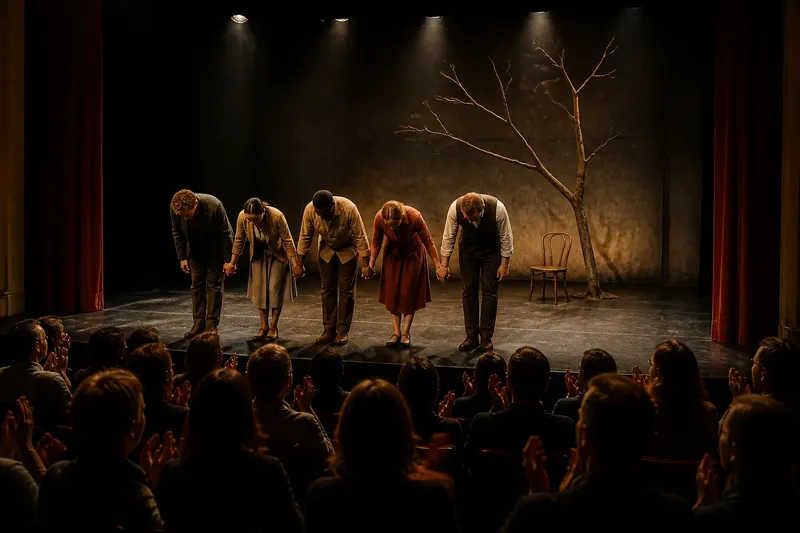
A repeated curtain call becomes part of the show when the audience’s response changes what performers do next. In a small theater, that shift can turn an ordinary closing convention into a moment people remember as belonging to the performance itself—not because every audience follows the same custom, but because one room develops its own rhythm.
Imagine a hypothetical production of a new play called The Glass Orchard, staged in a neighborhood theater. Its ending is quiet: the final character leaves an empty chair beneath a bare branch, and the lights fade. The actors then return for a conventional bow. On the first night, the applause continues after the cast has bowed and turned to leave. The stage manager brings them back once more. That return begins a pattern, but it does not yet explain why the moment might endure.
The First Return
At the first performance, the extra bow is a response to an unusually sustained ovation. The cast returns, bows again, and exits. This is still an extension of the evening’s ending, not necessarily a new artistic element. The distinction matters: audience enthusiasm can be vivid without becoming a stable feature of the show.
For the moment to take root, the response needs a recognizable shape. Perhaps several audience members keep clapping after the first bow, and others join them. The performers hear that the room is not ready to let the encounter end. The stage manager gives a familiar cue for the cast to return, and the actors acknowledge the audience again.
In this invented situation, the second bow is not planned as part of the script. It is an adjustment made in the room. The actors may sense that the audience is responding not only to the ending, but to the shared event of seeing the play together. Still, one evening cannot establish a tradition. The pattern has to recur, and it has to remain meaningful rather than become an automatic extra beat.
How Repetition Changes Meaning
Suppose the response happens again on later nights, though not every night. People who have attended before begin to expect that the cast may return if the applause continues. Newcomers see the first bow, hear the room remain active, and watch the performers come back. They learn the custom by observing it, not by reading a rule.
Each repetition changes the meaning slightly. The first return answered applause. Later, it can also recall earlier performances: the cast’s second bow becomes a recognizable sign that this audience and these performers have reached a particular kind of ending. A customary action acquires a memory beyond its immediate purpose.
That memory belongs to the exchange, not to the gesture alone. A bow can be routine in one venue and unusually charged in another. The same production may receive a second return in a crowded Saturday performance and none on a quiet weekday. Treating the response as universal would erase those differences and make an audience’s choice sound like an obligation.
The Cue and the Boundary
In the hypothetical play, the stage manager has a practical role in keeping the moment coherent. The manager watches for the cast’s exit, listens to the audience, and gives the agreed cue if another return is appropriate. This does not mean the manager can manufacture an ovation. It means a spontaneous response still takes place within the performance’s working conditions.
The cast also has to decide what kind of return fits the ending. A brief second bow might preserve the play’s quiet tone. A spoken thank-you could make the exchange warmer but also pull attention away from the final image of the empty chair. Neither choice is inherently better. The useful question is whether the action acknowledges the audience without replacing the ending that the production worked to create.
There is a boundary, too: applause is not a contract. Some viewers may leave promptly, remain quiet, or feel uncomfortable with a prolonged response. Others may be moved but not express it in a conventional way. A repeated curtain call can become part of a particular performance’s afterlife without becoming a test of whether the audience cared.
What the Audience Remembers
As the imagined run continues, audience members might describe the ending in different ways. One remembers the stillness before the lights faded. Another remembers the cast returning while the room kept clapping. Someone who attended more than once may recall the contrast between evenings when the second bow happened and evenings when it did not. These recollections do not compete; they show how a performance can gather meanings around a shared closing convention.
Suppose a visitor named Mara attends a later performance after hearing that the cast sometimes returns. She sees the final image, applauds with the rest of the room, and watches the actors leave after one bow. The expected second return does not happen. In this hypothetical situation, the observable result is not a failure of the custom: Mara has encountered a performance whose ending was complete without it. The possibility of variation is part of what keeps the response from becoming a compulsory ritual.
Performers may remember the exchange differently from audience members. For a cast, a second bow can mark a long evening of concentrated work and offer a direct moment of acknowledgment. Yet the gesture does not reveal private feelings or establish a single account of what the show meant. It is a public exchange, not a complete record of the people involved.
What Sustains the Custom?
In this case, the repeated return persists because several conditions line up: a clear ending leaves room for applause; the audience responds; performers can return without disrupting the production’s tone; and the stage manager has a way to coordinate the moment. If one condition changes, the custom may change too. A different cast, venue, audience, or ending can alter what feels natural.
The theater might choose to mention the possibility in a program note, but doing so could also turn an open response into an expectation. That is not automatically a problem; it is simply a different relationship. A performance that invites a return as a planned feature is making a different artistic choice from one that lets the audience’s response determine whether the cast comes back.
What is not worth the effort is trying to engineer applause by treating silence as a problem or prompting people to perform enthusiasm. That can make a shared moment feel managed rather than earned. A theater can prepare a clear cue and let the response remain uncertain.
Questions About Curtain Calls?
Is a second curtain call always planned?
No. It can be a spontaneous response to sustained applause, a planned part of a production, or a mixture of the two. The distinction depends on what the performers and production team have arranged.
Why do some audiences ask for another bow?
Some audiences continue clapping because they want to acknowledge the performers or prolong the encounter. Their reasons can vary, and a quiet response does not prove that a performance mattered less.
Can a repeated curtain call change an ending?
It can affect how people remember the closing moments, especially when the return becomes associated with a particular production or audience. It does not have to replace the scripted ending; it may instead become an additional moment after it.
Does every performance need a curtain call?
No. The form of acknowledgment depends on the production’s choices and the conventions of its setting. Some performances use bows, while others close in different ways or leave without a conventional curtain call.
A Memory Made Together
By the end of the imagined run of The Glass Orchard, the second bow has become part of what some people associate with the play, though it still does not occur at every performance. Its afterlife comes from repetition with room for variation: audiences recognize the possibility, performers answer when it fits, and each night remains its own event.
That is why a repeated curtain call can matter without becoming universal. It is not merely an extra bow or a dependable sign of approval. It is a small, visible record of how a performance was received in a particular room, and of how performers chose to meet that response. When people later describe the show, this exchange may sit beside the scenes and lines they remember, carrying the sound of one audience into the memory of the work.